Land of the arcane
Fantasy/Magitech 4X
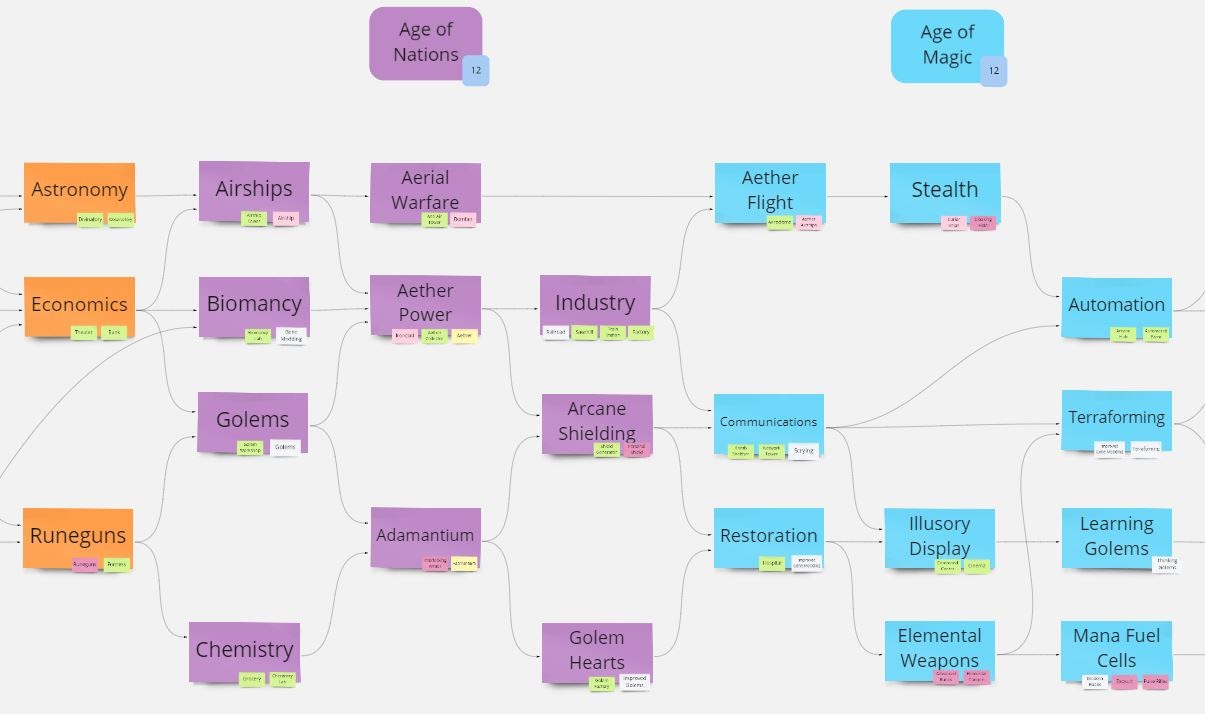
Part of the tech tree
Land of the arcane (LOTA) is a concept/design document for a 4X game I've been working on on and off for some time now and a game I want to make at some point. The problem is that while 4X's are a great genre, they don't fit well to indie game development.
I like tech trees, fantasy worldbuilding and magitech and so LOTA has been a way to combine those. The main part of the work has been designing a tech and civic tree, but I've also planned out worldbuilding, collected art references and designed systems for species, cultures and unit design.
There is nothing playable connected to LOTA and I haven't worked on it for a bit, but I would still love to make it into a game some day.
Things I've worked on:
- Initial idea, worldbuilding
- Tech and Civic trees
- Concept for a dynamic culture system.
- Ideas for a combat system and a unit editor.
- A pitch for the game
- Interactive visualizer for the tech and civic trees using Vis.Js
Land of the Arcane is 4X, similarly to games like Civilization, Humankind, Stellaris and more, but with a fantasy theme. It's obviously not the first fantasy 4X, games like Age of Wonders, Endless Legend and Thea: The Awakening exists. However they generally have a focus on war and conflict, while mostly ignoring economy, internal politics and diplomacy. They also tend to have a
pre-written narrative (a "main campaign"), instead of focusing on emergent narratives, like Civilization and Stellaris are so good at creating.
Land of the Arcane is instead designed more open, more dynamic, with player-made factions like Stellaris and a mostly symmetric start. I would roughly call it fantasy Civilization with Stellaris species editor.
The actual gameplay itself, I see being turn-based, but it could also be Paradox style realtime with pause. The world would be procedurally generated with world settings like starting a game of Civilization. Again it would probably be composed of hex tiles, but could instead have shaped provinces like Europa Universalis. One thing I would love to have is having the world be an actual sphere, instead of being a cylinder like the civilization games. This would create some challenges, but it is possible to create a sphere out of hexagons if you also have 12 pentagons. Those could be special, inaccessible tiles. Doing this would avoid projection issues and allow you to have a species that lives in snowy environments on the world's poles, and avoid the giant tundras Civ maps typically have. It’s extra good here in a fantasy setting as there could be civilizations (arctic elves, penguinfolk?) living on the poles and later on the game you might wanna fly your airships over the poles.
The Pitch
The setting of Land of the Arcane is one of mystery and discovery. The world is vast and full of magic. The world has many things we would recognize from ours. Plains, tundras, forests, deserts, mountains.
But your scouts will also uncover other things, magical things; floating islands, ancient ruins, mushroom forests, strange crystals and so much more. There are species connected to magic, elementals, drakes and spirits. But the real discoveries come from research.
Magic is not something mortals wield in Land of the Arcane, there are no Mages. There are no spellcasters blasting ranks of soldiers with fireballs, no clerics healing others by some god's grace. No mortals body can hold magic itself. But your civilization can still harness the arcane. In the early eras your smiths might draw runes on weapons that draw on the ambient mana, increasing their strength and durability. Later discoveries have your artificers storing magic or mana as they call it in special crystals, then using those to power devices of all sorts.
Magitech, they call it. Technology advances. The world is not stuck in the middle ages. The advancement is however based on magic and magical science. Technology follows a different path, one our world never could.
Airships dot the skies. First small ones built for exploration, using air for lift. Then as industries and factories are built, airship fleets are produced, made of metal, lifted by liquid mana, Aether.
Gunpowder isn't a thing, but armies still take to the field armed with Runeguns, propelling bullets by charged mana bursts. Following them are armies of golems, artificial creations animated by magic and made to serve. As science advances new weapons, materials and ideas are discovered and invented. Arcane barriers, adamantium, titanic golems, disintegration beams...
But Land of the Arcane is primarily not about war and conflict. A lot of fantasy games already focus on that. The real focus is on the society built on magic that you build.What government does your people have, what culture? How does golem servants change it? How does airship travel? What happens when we lift our cities to the skies? How does a society built on magic look?
Tech Trees
Above you can see and interact with the whole tech tree, made using the Vis.JS visualization library. Current work in progress
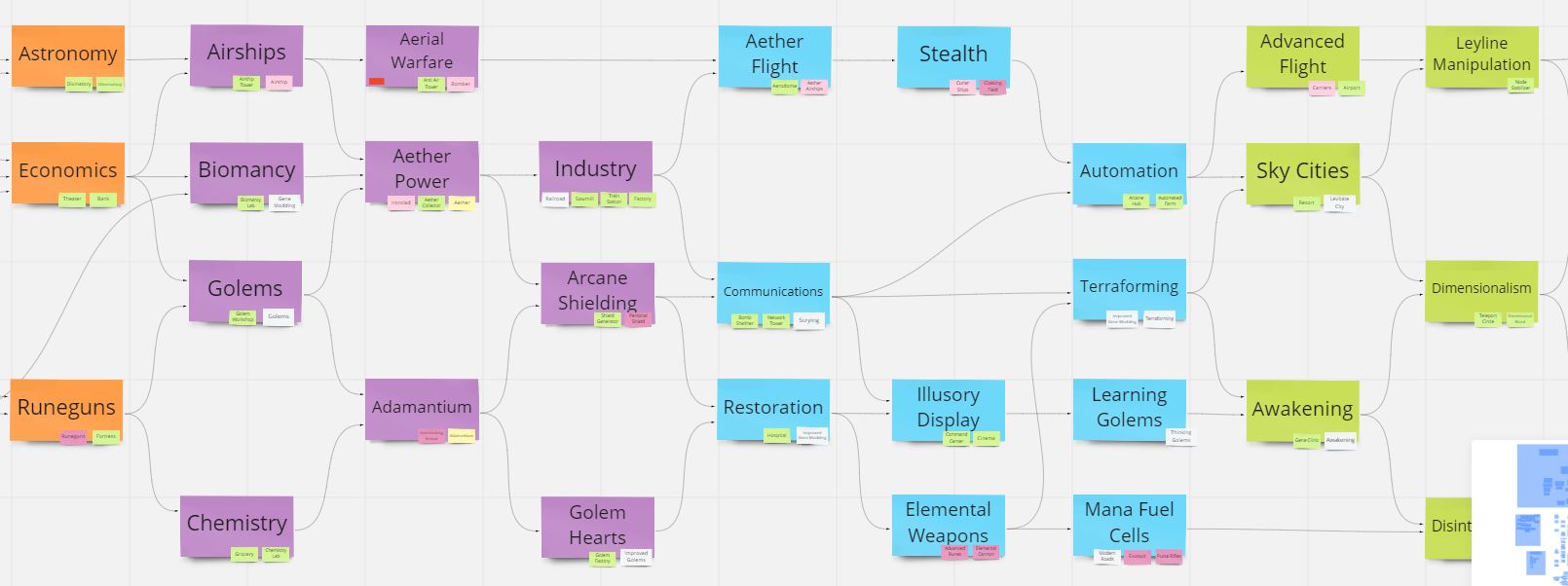
This is the current Tech tree for the Age of Nations (purple), Age of Magic (blue) and part of the Age of Wonder (green). This is the equivalent to the early industrial era to the information era or like 1600-2000 in our timeline
Making the tech tree was some of the first things I did for Land of the Arcane, and it's a fun combination of Game Design and Worldbuilding. I looked at the tech tree from many different games to see what technologies they highlight, how advancement works both mechanically and as a view of history. The tech trees I looked at the most were the ones used in Civilization 4, 5 and 6 and Humankind. I also looked at the Vox Pupuli and JNR mods for Civ 5 and 6 respectively to see how members of the community expand on tech trees.
Game Design wise I set up a few rules for myself. Each era has 10 techs spread out in 3 steps. Each tech has a maximum of three required techs and three techs it leads to. To start making the tech tree I made cards for some of the technologies I really wanted in the game; Airships, Magitech, Golems, Leyline Manipulation, Runes... I focused on concepts I liked and that fit the world I was making. Then I worked on figuring out what technologies I would need to connect to them and how many techs and eras it should have total. Over the course of designing the era and tech count has steadily expanded, and right now it's at 60 techs over 6 eras. That felt like a good amount to carry a sense of progression and scope without making individual techs feel pointless
On the techs there are smaller notes in different colours, which are things unlocked by the techs. These are right now concepts/features (white), buildings (green), weapons/armor (purple) and resources (yellow). They might be a bit hard to read here, but I am hoping to update the vis.js visualiser with them soon.
Civic Tree
Above you can see and interact with the whole civic tree, made using the Vis.JS visualization library. Current work in progress
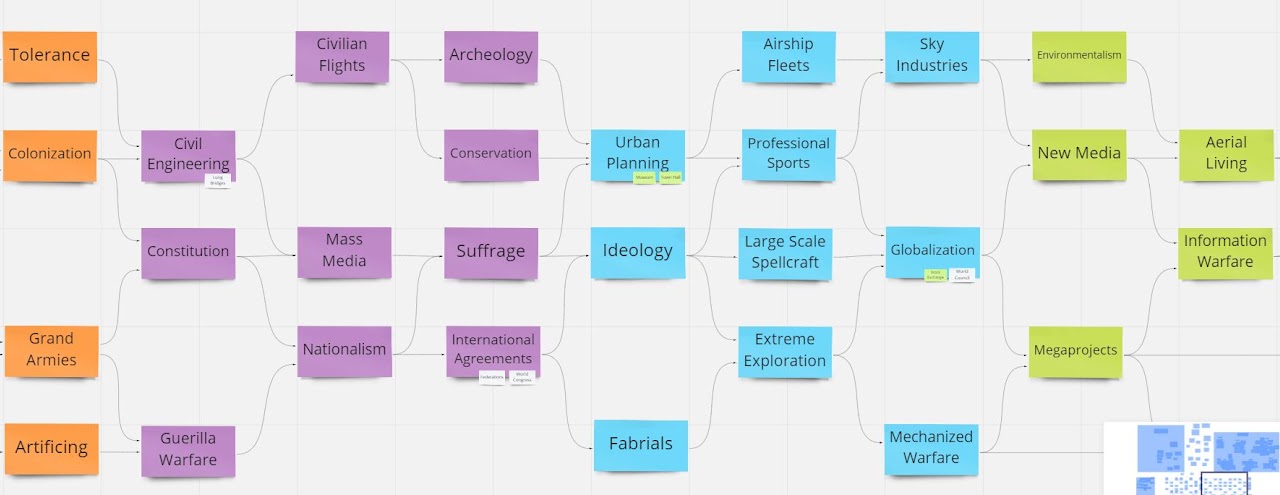
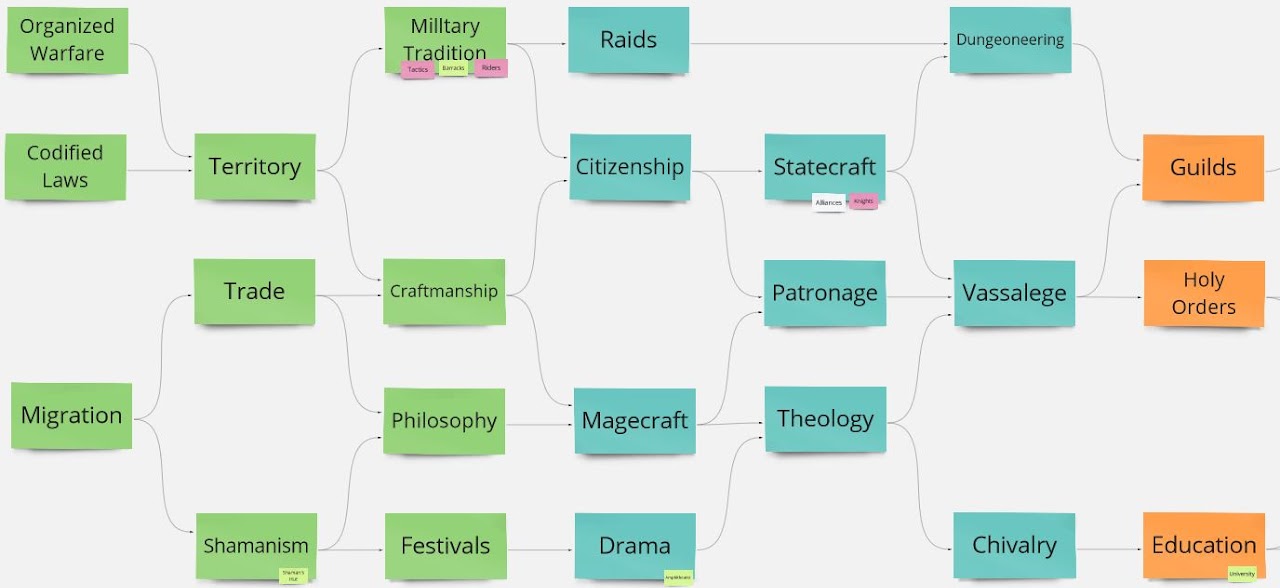
This is the current Civic tree for the Age of Nations (purple), Age of Magic (blue) and part of the Age of Wonder (green). This is the equivalent to the early industrial era to the information era or like 1600-2000 in our timeline
As I was looking at different tech trees I found some interesting comparisons between Humankind which has more technologies that touch on social developments and military strategies, and Civilization which generally has more technologies regarding material science and religion. Civilization 6 however did something interesting by splitting its technology tree into Civics and Techs in two separate trees, which I think was a great idea, and just copied. It shows cultural and societal development in a great way and prevents scenarios where you build a laboratory to "research" “techs” like ideology or professional sports. Of course there are nuances that both systems miss, your radio stations in your nations aren't inventing Urban Planning, but it's a good approximation.
This tree might appear to follow our world's progress far more than the tech tree, but that's because magic doesn't stop revolutions. People whether they are elves, orcs, humans or lizardfolk will want representation and rights. They will also invent sports and arts. The way these things take form in the Land of the Arcane will of course be different though. Skyship racing is a popular sport, at least for the rich. Mechanized warfare does not come from tanks, it comes from armies of golems. Information warfare is done via scrying, divination and warded rooms in government buildings.
Then of course some things are new. Our world's most extreme exploration might be the poles or the deep sea. Here there are floating islands, crystal forests and giant underground caverns to explore. Our world may have skyscrapers but we don't have floating islands, either man made or artificial. (yet?). When a rich enough government can make their biggest cities float, that has some socioeconomic impacts.
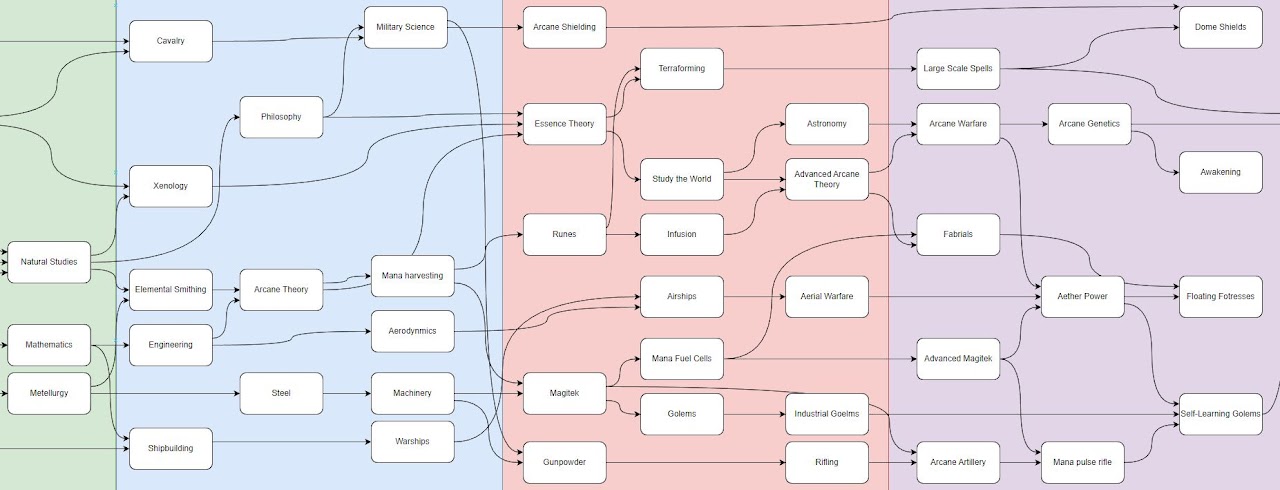
My old Technology Tree from back in 2019, made in diagrams.net which is the first iteration of this tree. It’s a bit harder to follow, yes. I think I learned some more UI design between then and now. Comparing the two techs trees can see many of the same techs, but also noticeable differences. Besides that fact the old tech tree is less structured and harder to read, the order of techs is different. The second, blue era of the is/was called the Age of Kingdoms and generally encompasses what we might call the classical and early medieval era in our world. It probably shouldn't have Steel and Aerodynamics.
The bigger problem with this tech tree was "Theory" techs, which are unclear what they actually mean and represent. A real world technology tree always has an advantage in that the player can use their historical knowledge to get a rough idea what different technologies do by just reading their names. Land of the Arcane is still a fantasy setting, but by avoiding vague tech names like "Essence Theory", "Arcane Warfare" and "Advanced Arcane Theory" that in of themselves don't tell anything, I can still help new players parse the tech tree and get an idea of what they are about.
Other Things
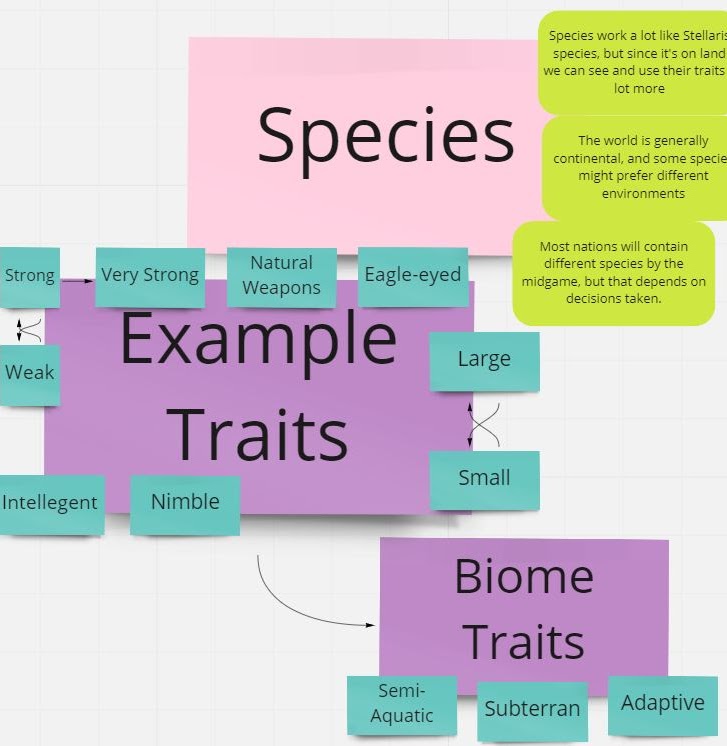
At the start of the game you design a species by picking traits and appearance. Species traits are things like "Strong", "Small" and "Adaptive" and have an impact on the game. Strong species deal more melee damage in battle and have a higher production. A small species requires less housing but does less damage. Adaptive species (like humans) can settle in more types of terrain, while Lizardfolk might struggle outside of hot climates.
After you designed your species, you now have a tribe of people looking for a place to settle in a vast world. The start of your journey. And your opponents do the same thing. Here the game follows a lot of 4X standards. Explore the world, expand your nation, exploit resources. Exterminate?
Diplomacy is important. Generally the world would have a few different tribes of most species so there isn't just one "Elven Kingdom". You aren’t leading the world's only dwarven settlers, there is another faction of them over there (though the option of being the only one of your species could still exist for challenge runs and roleplay). You will see multiple nations of most species and pretty soon multispecies nations. This comes with advantages, having a larger population and the ability to use different traits for different things. Do you have strong, durable turtle people that immigrated to your country? That's a nice elite durable vanguard. Your nimble, intelligent lizardfolk, they make good spies and scouts.
Still, of course having a multispecies nation isn't without issues and internal politics…
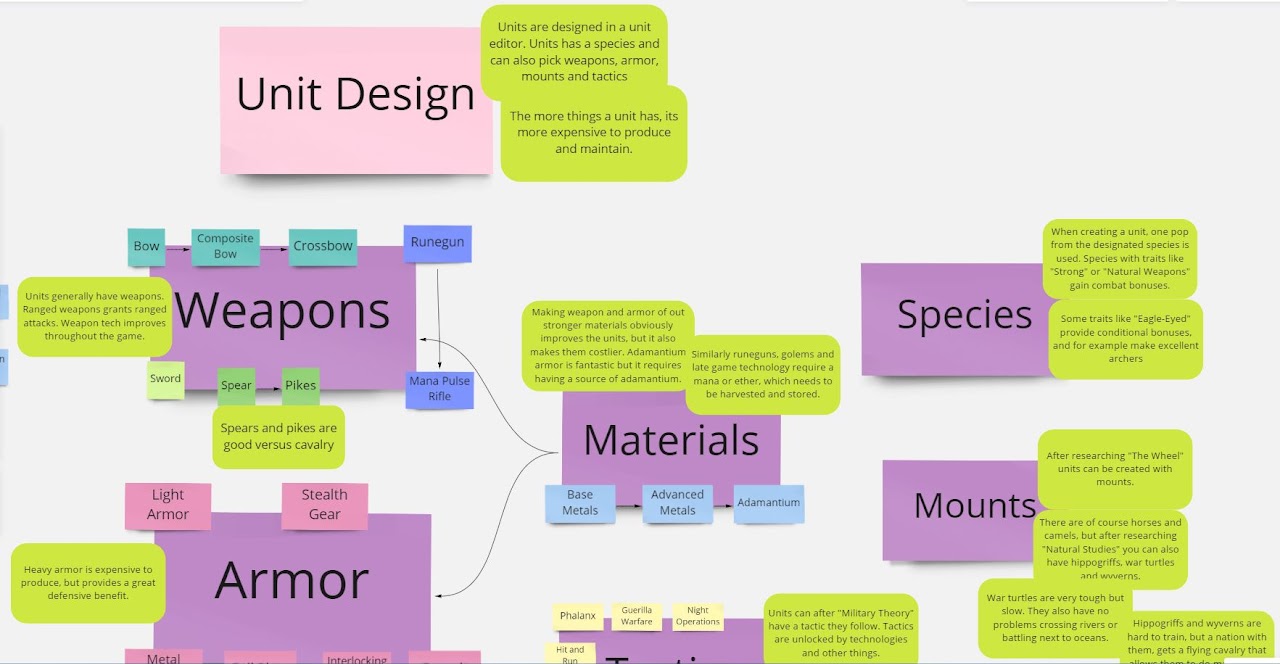
Instead of having predefined units that are unlocked on different conditions, Land of the Arcane has a unit designer. Here you can pick the weapons, armor, materials in the armor and of course species of your unit. In order to be able to use a type of weapon or armor you must first unlock it, which would generally be done in the tech tree. At the start of the game your only weapon option would be clubs, but you quickly get access to spears by researching mining. and then your first ranged option in bows by researching Carpentry.
The goal of the unit editor would be to add customizability to the game and to allow for more varied scenarios. A mana poor nation or one with an honourbound culture might decide to forgo Runeguns and instead outfit their armies in adamantium armor, runes of shielding and melee weapons. It would be an expensive army to build, but a durable one, that could beat a runegun regiment. Due to their lack of ranged attacks they would have a problem fighting back against airships though.
On the other hand Runeguns might be good for a revolutionary militia that doesn't have time to train with traditional weapons. An intelligent and weak science loving species might let their entire army be composed of golems. With enough resources, that's a durable army that doesn't need to sleep and can march far. Could be a problem if those Golems start to think for themselves though...
Inspiration
While Land of the Arcane is a fantasy setting, it should be clear by now that traditional fantasy works like Lord of the Rings aren't its primary inspiration source. Rather a lot of inspiration has been taken from settings like Eberron, Ravnica, Kaladesh/Avishkar, Runeterra and the worlds of works like Fullmetal Alchemist, Wandering Inn, Mother of Learning, Arcane Ascension and Final Fantasy. Worlds where magic is everywhere and can be harnessed.
Still Land of the Arcane is also about the journey there, how your nation goes from petty tribe in a large world full of wonder and danger, to a kingdom starting to understand magic around you, to an empire or federation spanning a continent with fleets of airships, gigantic golems, cities in the skies and dimensional portals between cities. Some of the inspiration was actually from the excellent Minecraft mod Thaumcraft, where the player has a similar journey but on a much smaller scale.